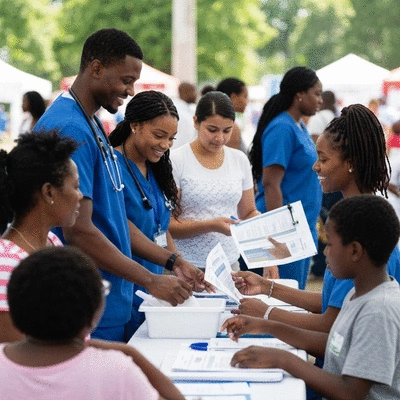
Pillar 1:
Defining Health Equity & Impact
Ensuring everyone has fair opportunity for best health, particularly for communities of color affected by social and economic factors.
What if your next step could lead to groundbreaking health improvements in your community? The Maryland State Chapter of the National Medical Association invites you to explore the transformative power of health equity workshops. These sessions are more than just a chance to learn; they are opportunities to become part of a movement that advocates for the well-being of communities of color.
The pursuit of health equity is a multifaceted endeavor, focusing on critical areas to ensure fair access and outcomes. Below are the three main pillars that guide efforts in achieving health equity, with a focus on communities of color.
Ensuring everyone has fair opportunity for best health, particularly for communities of color affected by social and economic factors.
Identifying gaps in healthcare access and outcomes, crucial for developing effective interventions and advocacy.
Addressing factors like income, education, and environment profoundly influencing health outcomes for individuals.
In our ever-evolving healthcare landscape, the significance of health equity cannot be overstated. At the Maryland State Chapter of the National Medical Association, we understand that health equity is about ensuring everyone has a fair chance to achieve their best health. This means addressing systemic barriers that affect communities of color and working towards a health system that serves all of us equitably.
Health equity is more than just a term; it represents a vital mission that guides our workshops and community initiatives. By providing culturally relevant health education, we strive to empower African American physicians and enhance health outcomes within these communities.
Health equity refers to the idea that every individual deserves the opportunity to attain their highest level of health, regardless of their background or circumstances. This is particularly important for communities of color, where social and economic factors often create disparities in health outcomes. For example, the 2024 CMS Health Equity Conference highlights ongoing efforts to address these disparities at a national level.
When we address these disparities, we not only improve individual health but uplift entire communities. For instance, equitable access to healthcare services can lead to reduced mortality rates and improved quality of life, fostering a sense of hope and resilience.
Health disparities are gaps in healthcare access and outcomes between different population groups. In Maryland, we see these disparities manifest in various ways, including differences in chronic disease prevalence, access to care, and health literacy. Understanding these disparities is crucial for developing effective interventions, as explored in initiatives like the Health Equity Institute.
By highlighting these issues in our workshops, we aim to equip physicians and community leaders with the knowledge needed to advocate for their patients effectively. Together, we can create a healthier Maryland for everyone.
Social determinants of health, such as income, education, and environment, play a significant role in shaping health outcomes. These factors can profoundly influence an individual's ability to attain good health. For example, individuals living in low-income neighborhoods may face barriers like limited access to healthy food and safe recreational spaces.
Addressing these determinants is critical in our workshops, as they guide our approach to creating tailored health initiatives for communities of color. Workshops like the Communities, Climate Change, and Health Equity workshop series further emphasize the intersection of environmental factors and health equity.
The National Medical Association (NMA) has been at the forefront of advocating for health equity since its founding in 1895. Our mission is clear: to ensure that African American physicians can effectively advocate for their patients and provide the best care possible. At the Maryland chapter, we share this commitment to advancing health equity through education and community engagement.
By fostering a collaborative environment among healthcare professionals, we can amplify the voices of Black physicians and address the unique health challenges faced by our communities.
Through targeted initiatives, the NMA works to dismantle the barriers that contribute to health disparities. We conduct workshops that focus on best practices for addressing the specific needs of African American populations. Our goal is to empower physicians with the tools necessary for effective advocacy and patient care.
These initiatives not only benefit individual health but contribute to the overall improvement of public health systems. Our work is a testament to the power of community-focused health education.
Community engagement is key to our mission at the Maryland NMA. We actively involve community members in our workshops, ensuring that their voices and experiences shape our programs. This collaboration enables us to create solutions that are relevant and effective.
By bringing together physicians, patients, and community advocates, we cultivate a network of support that works towards health equity. Together, we can address the root causes of health disparities and foster a healthier, more equitable Maryland.
To maximize the impact of your participation in health equity workshops, consider bringing a friend or colleague along. Sharing insights and experiences with others can enhance understanding and foster collaborative advocacy efforts within your community. Together, you can brainstorm actionable steps to implement the knowledge gained and support one another in addressing health disparities!
Participating in health equity workshops is not just an opportunity for education; it’s a catalyst for change! Through these workshops, attendees can gain valuable insights into the health challenges faced by communities of color and learn how to address them effectively. Here are some essential reasons why your participation matters:
As we reflect on the importance of these workshops, it’s clear they play a vital role in enhancing overall community well-being. This is crucial in a landscape where health outcomes can be drastically different based solely on one’s race or zip code!
Workshops led by the Maryland State Chapter of the National Medical Association are designed to elevate awareness surrounding health issues that disproportionately affect communities of color. Participating in these events ensures that you are informed about the latest research, trends, and strategies to combat health disparities. Informed community members can advocate more effectively for their health needs and those of their families.
These workshops also encourage dialogue and connection among attendees. They create a supportive environment where personal experiences and local challenges can be shared, ultimately leading to collaborative efforts in seeking solutions!
The fight for health equity is ongoing, and workshops serve as a reminder of this critical mission. They not only provide valuable education but also inspire action. By becoming actively involved, you contribute to a larger movement advocating for systemic change in healthcare. Our commitment to health equity is reflected in our mission, and we encourage everyone to embrace this cause with us.
As you think about health equity, consider how you can take part in advocacy efforts within your community. Each voice raised contributes to a more equitable healthcare system!
One of the primary goals of these workshops is to assess health outcomes and identify strategies for quality improvement. By gathering data and sharing experiences, participants can develop a better understanding of what works in different community contexts. This information is essential for tailoring interventions and ensuring they meet the specific needs of diverse populations.
Moreover, by evaluating the effectiveness of past initiatives, we can refine our approaches and enhance the impact of our future efforts. It’s about learning from one another and adapting strategies to yield the best results in our communities!
Now that you understand the value of participating in health equity workshops, it’s time to get involved! Here’s how you can stay connected and contribute:
We invite you to engage with the Maryland State Chapter of the National Medical Association and take an active role in promoting health equity. Together, we can champion the health and well-being of communities of color and ensure that every voice is heard!
Here is a quick recap of the important points discussed in the article:
The Maryland State Chapter of the National Medical Association, is a group of dedicated physicians and advocates for health equity, specializing in the advancement of culturally relevant health education.
With many years of experience in both clinical practice and community outreach, Our physicians are passionate about empowering other African American physicians and enhancing the health outcomes of communities of color.
Their commitment to advocacy and leadership drives the mission of The Maryland State Chapter of the National Medical Association, where dedicated physicians work to amplify the voices of Black physicians nationwide.
The NMA is national professional and scientific organization that represents the interests of 50,000 african american physicians who are the leading advocates for their patients.
The NMA was founded in 1895 and is the oldest organization representing AA physicans and their patients and health care workers.
Current Maryland Leadership
President Stephen McKenna MD
Vice President Darryl Hill MD